The most common zodiac signs by country are the summer signs. In more than 105 million births from the US, England and Wales, Denmark and Mexico, the top Sun sign is always Leo, Cancer or Virgo. Capricorn or Pisces comes last. Every Sun sign falls between 7.39% and 9.46% of births, close to an even 8.33%. Rising signs are a different story. Depending on latitude, some are up to seven times more common than others.
Five findings from 105 million births
Leo is the most common Sun sign in the US, with 8.96% of births from 1994 to 2014.
Cancer leads in England and Wales (8.82%) and in Denmark (9.22%). Virgo leads in Mexico, with 9.46% of births in 2019 and 2020.
Capricorn is the rarest Sun sign in the US (7.62%), in England and Wales (7.79%) and in Denmark (7.39%). In Mexico the rarest is Pisces (7.81%).
Rising signs vary far more than Sun signs. In Norway, Leo and Scorpio rising are each about 7.4 times as common as Aries and Pisces rising (14.1% against 1.9%).
South of the equator the order flips. In Australia, Taurus and Aquarius are the most common rising signs (10.1% each) and Virgo and Libra the rarest (5.6% each).
Most common Sun signs by country
I worked with official records of births by day from four countries. For each day I split the births across the Sun signs, using the moment when the Sun changed sign. If all twelve signs were equally common, each would have 8.33%.
| Sun sign | US | England and Wales | Denmark | Mexico |
|---|---|---|---|---|
| Aries | 8.15% | 8.14% | 8.00% | 7.97% |
| Taurus | 8.32% | 8.43% | 8.36% | 8.08% |
| Gemini | 8.57% | 8.64% | 8.78% | 8.35% |
| Cancer | 8.86% | 8.82% | 9.22% | 8.47% |
| Leo | 8.96% | 8.75% | 9.18% | 9.00% |
| Virgo | 8.92% | 8.67% | 8.87% | 9.46% |
| Libra | 8.51% | 8.62% | 8.60% | 9.00% |
| Scorpio | 8.15% | 8.16% | 8.02% | 8.24% |
| Sagittarius | 7.94% | 7.97% | 7.57% | 7.84% |
| Capricorn | 7.62% | 7.79% | 7.39% | 7.86% |
| Aquarius | 7.93% | 7.95% | 7.98% | 7.91% |
| Pisces | 8.06% | 8.08% | 8.03% | 7.81% |
The US column covers 85,712,738 births from 1994 to 2014. The data come from the CDC for 1994 to 1999 and from the Social Security Administration for 2000 to 2014, as published by FiveThirtyEight. England and Wales covers 14,639,906 births from 1995 to 2016, from the Office for National Statistics. Denmark covers 1,145,696 births from 2007 to 2025, from Statistics Denmark (table FODDAG). Mexico covers 3,638,903 babies born in 2019 and 2020, from INEGI. Together that is a little over 105 million births.
Rarest to most common zodiac sign in the US
From rarest to most common, the US order is Capricorn (7.62%), Aquarius (7.93%), Sagittarius (7.94%), Pisces (8.06%), Scorpio and Aries (8.15% each), Taurus (8.32%), Libra (8.51%), Gemini (8.57%), Cancer (8.86%), Virgo (8.92%) and Leo (8.96%). Aquarius and Sagittarius are less than a hundredth of a point apart, so in practice they are tied.
Why the summer signs come out ahead
Two things push Cancer, Leo and Virgo to the top. The first is the calendar of births. In all four countries more babies are born from July to September than in winter. September has the most births per day in the US, in England and Wales and in Mexico. In Denmark it is July. The month with the fewest births per day is January in the US and December in the other three countries.
The second reason is astronomical. The Sun does not spend the same number of days in every sign. Averaged over 1994 to 2014, it stays 31.45 days in Cancer, 31.30 in Leo and 30.90 in Virgo. Capricorn gets the shortest stay, 29.44 days. Between July 3 and 6 each year the Earth passes the point of its orbit farthest from the Sun. It moves a little more slowly there. That is why the summer signs last longer.
If you correct for those longer stays and count births per day of the Sun's stay, the picture changes slightly. In total there are more Leos than Virgos in the US, because the Sun spends about ten hours longer in Leo. On an average day of each season, though, more babies are born in Virgo season, 11,784 against 11,685 in Leo season. Capricorn is last with 10,568 a day. In England and Wales the leader per day is Libra (1,887) and the last is Capricorn (1,758). In Denmark Capricorn is also last, with 151 births per day.
Mexico, where Virgo leads
Is Virgo the most common zodiac sign? In Mexico it is. Virgo takes 9.46% of births, the highest share of any sign in any of the four countries. Leo and Libra follow with 9.00% each. At the other end Pisces has 7.81%, just below Sagittarius (7.84%) and Capricorn (7.86%).
The Mexican data are also the most precise in this study. Of the 3,638,903 babies born in 2019 and 2020 (registered from 2019 to 2022), 3,570,688 have their hour and minute of birth recorded. For them the Sun sign is exact, with no estimate at all.
September is the month with the most births in Mexico, an average of 5,671 a day in 2019 and 2020. Why September peaks there is a question for demographers. I won't guess at it.
The rarest rising sign, country by country
Your rising sign (also called the Ascendant) is the sign that was coming up on the eastern horizon when you were born. On average it changes every two hours, but some signs rise much faster than others. Working it out for a single person needs an exact birth time. For a whole population it can be estimated, because some signs take much longer to rise than others. The figures below are estimates of the share of each rising sign in each country's population. They do not tell anyone their own Ascendant.
| Country | Average latitude | Most common rising signs | Rarest | Difference |
|---|---|---|---|---|
| Norway | 60.8° N | Leo and Scorpio, 14.1% each | Aries and Pisces, 1.9% | 7.4 times |
| Sweden | 58.8° N | Leo and Scorpio, 13.3% | Aries and Pisces, 2.3% | 5.9 times |
| Denmark | 55.9° N | Virgo, Libra, Leo and Scorpio, 12.6% | Aries and Pisces, 2.9% | 4.3 times |
| Ireland | 53.1° N | Virgo, Libra, Leo and Scorpio, 12.1% | Aries and Pisces, 3.4% | 3.6 times |
| United Kingdom | 52.6° N | Virgo, Libra, Leo and Scorpio, 12.0% | Aries and Pisces, 3.5% | 3.5 times |
| Canada | 46.6° N | Leo, Scorpio, Virgo and Libra, 11.2% | Aries and Pisces, 4.3% | 2.6 times |
| Spain | 39.5° N | Leo and Scorpio, 10.5% | Aries and Pisces, 5.1% | 2.1 times |
| US | 37.6° N | Leo and Scorpio, 10.4% | Aries and Pisces, 5.2% | 2.0 times |
| Cuba | 22.1° N | Cancer, Sagittarius, Leo and Scorpio, 9.4% | Aries and Pisces, 6.4% | 1.5 times |
| Mexico | 21.3° N | Cancer and Sagittarius, 9.4% | Aries and Pisces, 6.5% | 1.4 times |
| Colombia | 5.9° N | Cancer and Sagittarius, 9.1% | Aries and Pisces, 7.4% | 1.2 times |
| Brazil | 17.1° S | Gemini and Capricorn, 9.3% | Virgo and Libra, 6.7-6.8% | 1.4 times |
| Argentina | 32.8° S | Taurus and Aquarius, 10.0% | Virgo and Libra, 5.6% | 1.8 times |
| Australia | 33.0° S | Taurus and Aquarius, 10.1% | Virgo and Libra, 5.6% | 1.8 times |
| New Zealand | 39.3° S | Taurus and Aquarius, 10.5% | Virgo and Libra, 5.1% | 2.1 times |
Rising signs come in pairs that are almost tied. Virgo goes with Libra, Leo with Scorpio, Cancer with Sagittarius, Gemini with Capricorn, Taurus with Aquarius and Aries with Pisces. That is why the table lists a group of most common signs. There is no single winner. The pairing is not new. In the second century Ptolemy noted in the Tetrabiblos (book I, chapter 14) that signs at the same distance from an equinox rise in equal times. Astrological tradition calls them signs of long ascension and signs of short ascension.
In Spain, Virgo and Libra are close behind Leo and Scorpio, at about 10.4%. In the southern hemisphere Aries and Pisces move up among the most common rising signs, with 9.9% in Argentina and Australia and 10.4% in New Zealand.
If you would like to know your own rising sign, the free Sun, Moon and Rising Sign Calculator works it out from your birth date, time and place. The course lesson on the four angles explains what the Ascendant does in a chart.
Why Aries and Pisces are the rarest rising signs
Most countries do not publish the hour of each birth. The estimate still works. The reason fits in three steps. Finding your own rising sign without a birth time is a different question with its own article.
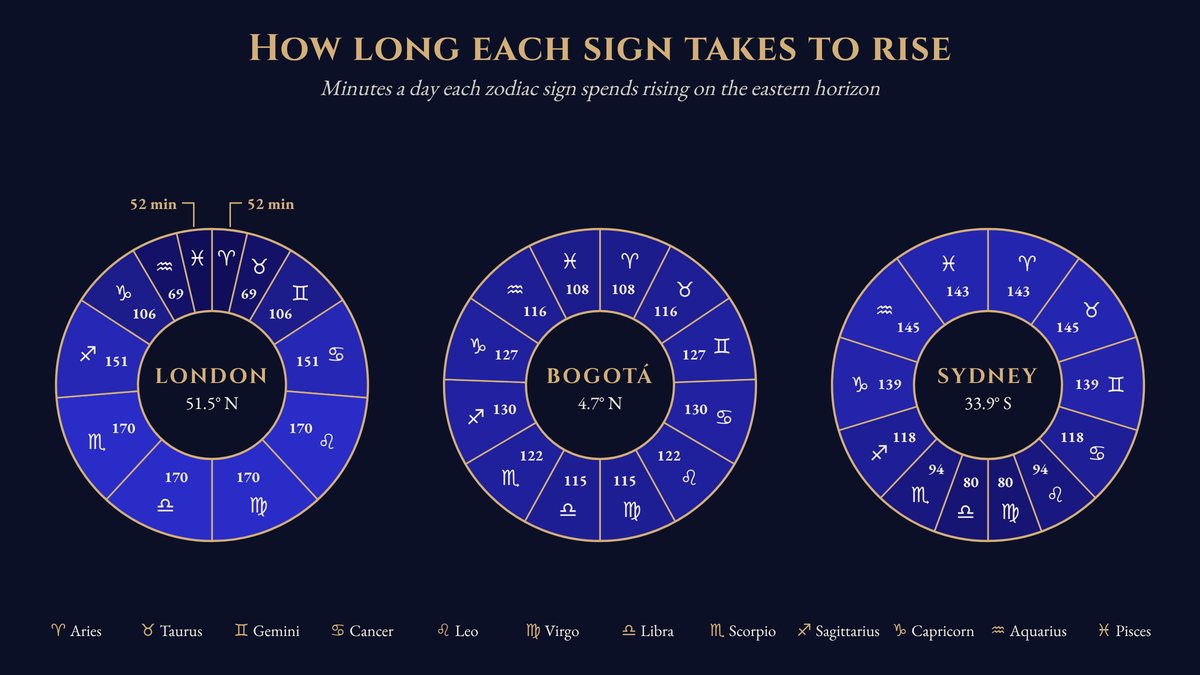
First, the time each sign takes to rise depends only on latitude. In London, Aries and Pisces each take about 52 minutes to cross the horizon. Virgo and Libra take about 170 minutes, close to three hours.
| City | Aries and Pisces | Taurus and Aquarius | Gemini and Capricorn | Cancer and Sagittarius | Leo and Scorpio | Virgo and Libra |
|---|---|---|---|---|---|---|
| London (51.5° N) | 52 | 69 | 106 | 151 | 170 | 170 |
| Madrid (40.4° N) | 72 | 86 | 115 | 142 | 152 | 151 |
| Bogotá (4.7° N) | 108 | 116 | 127 | 130 | 122 | 115 |
| Sydney (33.9° S) | 143 | 145 | 139 | 118 | 94 | 80 |
Second, the same sign rises about four minutes earlier each day, roughly two hours earlier each month. Over a year, any busy hour for births passes through all twelve signs and favors none of them.
Third, the only thing that does not even out is the length of each sign's turn. If Libra spends almost three hours on the horizon and Aries less than one, more people are born with Libra rising.
One way to picture it is twelve doors that open in turn during the day. Some stay open much longer than others. Each day the sequence starts a little earlier. Someone who always walks past at the same hour will find the long-open doors far more often.
Testing the estimate with real birth times
Mexico made it possible to check the method against real births. For the 3,570,688 babies born in 2019 and 2020 with a recorded hour and minute, I calculated the actual Ascendant of each one. I used the time zone of their state on that date and the average location of the state's population.
The real result and the estimate from latitude differ by 0.23 percentage points at most, in a single sign. Aries and Pisces rising come out at 6.33% each with real birth times, against 6.5% in the estimate. That holds even though births are far from even across the day. In Mexico 6.8% of babies are born between 9 and 10 in the morning against about 2.7% in each hour between 3 and 6 a.m.
The southern hemisphere and the equator
South of the equator the signs of long and short ascension swap places. Virgo and Libra become the rarest rising signs, while Taurus, Aquarius, Aries and Pisces move toward the top. Brazil sits closer to the equator and its differences are smaller. Its order is already the southern one.
Near the equator the signs rise in more similar times. Colombia has the smallest gap of the fifteen countries, with the most common rising signs 1.2 times as frequent as the rarest. Even there the twelve are not equal. In Bogotá the time each sign takes to rise runs from 108 to 130 minutes.
Countries without Sun sign data
Several countries appear in the rising sign table but not in the Sun sign table. The reason in each case is the data that their statistics offices publish.
Spain's INE publishes the month of birth but not the day. A month cannot be split between two signs without guessing, because the Sun changes sign around the 20th. Colombia's DANE also publishes only the month. Australia's ABS released a ranking of birth dates for 2007 to 2016 without the counts behind it. Sweden and Norway have published only short lists of their most common birthdays. For Canada, Ireland and New Zealand I could not find a public series of births by day. The records of Brazil, Argentina and Cuba were not accessible.
Method and limits
For Sun signs, I divided each day of births at the exact moment the Sun changed sign, in local time and with daylight saving time where it applied. In Mexico I used the real time of birth. The 1.9% of Mexican births without a recorded time were spread across the day. In the US, switching the time zone from New York to Los Angeles moves the results by 0.003 points at most.
For rising signs, I calculated with Swiss Ephemeris the share of the day each sign spends rising, every quarter of a degree of latitude. I then weighted those shares by where people live, using every place with 500 or more inhabitants in the GeoNames gazetteer. GeoNames records less population than the real total in Argentina and Colombia. Their latitude, which is what matters here, is still well spread.
I also tested how sensitive the rising sign estimate is. I applied the real pattern of birth hours in Mexico, the day-by-day US births of 2014 and the change to daylight saving time to London and Madrid. Their figures change by 0.24 points at most.
Each country covers its own years, depending on what its statistics office publishes. Everything uses the tropical zodiac. The zodiac signs, the Ascendant and the signs of long and short ascension are ancient ideas. Swiss Ephemeris and GeoNames are modern tools that make it possible to count them across millions of births.
Download the data and how to cite it
The full tables, with every country and every sign, are available as a CSV file under a Creative Commons Attribution 4.0 license (CC BY 4.0). You are free to use them as long as you cite the source.
Suggested citation. David S.R., AstroDavidSR, "The Most Common Zodiac Signs by Country, Counted From Real Birth Records", astrodavidsr.com, October 2026.
If you would like to see what your own Sun sign and Ascendant say together, that is the work of a full birth chart reading.
Sources
- Centers for Disease Control and Prevention, National Center for Health Statistics, births by date, 1994 to 2003 (used here for 1994 to 1999).
- Social Security Administration, births by date, 2000 to 2014. Both series compiled by FiveThirtyEight.
- Office for National Statistics, "Number of live births by date, 1995 to 2016, in England and Wales".
- Statistics Denmark, table FODDAG.
- INEGI, Estadísticas de Natalidad, open data (records from 2019 to 2022).
- GeoNames, cities500 gazetteer.
- Swiss Ephemeris, Astrodienst.
- Ptolemy, Tetrabiblos, book I, chapter 14.
Frequently asked questions
What is the most common zodiac sign?
It depends on the country, though it is always a summer sign. In over 105 million births, Leo is the most common Sun sign in the US (8.96%). Cancer leads in England and Wales (8.82%) and in Denmark (9.22%). Virgo leads in Mexico (9.46%). More births in late summer and the Sun's longer stay in those signs explain most of the gap.
What is the rarest zodiac sign?
Capricorn is the rarest Sun sign in the US (7.62%), in England and Wales (7.79%) and in Denmark (7.39%). The Sun spends the fewest days in Capricorn, about 29.44 on average. Fewer babies are also born in winter. In Mexico the rarest is Pisces (7.81%), just ahead of Sagittarius and Capricorn.
Is Virgo the most common zodiac sign?
In Mexico it is, with 9.46% of births in 2019 and 2020. In the US Virgo comes second in total (8.92%) behind Leo (8.96%). On an average day of its season, though, Virgo has the most US births of any sign, 11,784. In England and Wales and in Denmark, Cancer comes first.
What is the rarest rising sign?
In the northern hemisphere, Aries and Pisces rising are the rarest. In Norway each is about 1.9% of the population, in the UK 3.5% and in the US 5.2%. In the southern hemisphere the rarest are Virgo and Libra rising, at 5.6% in Argentina and Australia. These are population estimates, not anyone's personal Ascendant.
Why is Pisces the rarest rising sign?
In the northern hemisphere Pisces and Aries rise faster than any other sign. In London each takes about 52 minutes to cross the horizon, while Virgo and Libra take about 170. Over a year, each sign rises at every hour of the day, so the busy hours for births favor none of them. The signs that stay longer on the horizon collect more births. The farther north, the bigger the difference.
What is the rarest rising sign in the southern hemisphere?
Virgo and Libra. South of the equator the signs of long and short ascension swap places. In Australia and Argentina, Virgo and Libra rising are each about 5.6% of the population and in New Zealand 5.1%. Taurus and Aquarius are the most common, around 10%. Aries and Pisces are among the most common too.