Everyone has a place where they got hurt early and never fully got over it. The specific one, deeper than the ordinary bruises everyone collects, the theme that keeps coming back in different clothes across a whole life, the thing you are almost too quick to spot in other people because you know exactly how it feels from the inside. That last part is the strange gift buried in it. The exact place you were wounded tends to become the place other people come to you for help, because you had to work it out the hard way and most of them never did. In a chart that place has a name, and it is the first of the three things you have left to meet.
None of the three is a planet. After ten actors that each do a job, these last three work differently. They are the sensitive points of the chart, the places where the map stops describing how you function and starts telling your story, where you have been and where you are still tender. One of them is ancient and the other two are modern, and it is worth keeping that straight the way we have kept it straight all along.
Chiron
Chiron is the wound that does not fully close.
It is modern, a small body found out past Saturn not that long ago, so the tradition worked without it for most of its history and only folded it in recently. What it marks is that early injury, usually something you did not choose and could not fix, in the area of life the sign and the house will name later. Pop astrology likes to make Chiron pretty, a soft story about being sensitive. The real thing is harder and more useful than that. Chiron is where you walk with a limp nobody else can see, and it is also, for that exact reason, where you end up wise. You cannot fake the kind of understanding that comes from having lived inside a problem for years. People feel that you actually know, and they trust it. That is what the old phrase wounded healer is pointing at, and it is less a metaphor than a plain description of how real authority gets built.
If you want to go deeper into your own Chiron once you know where it sits, there is a full guide to it on the site, sign by sign. The Chiron guide is the place for that.
Lilith
Lilith is not a body either. Like the nodes you are about to meet, it is a calculated point, the empty spot that marks where the Moon swings farthest from the Earth, and its use is modern. The tradition did not work with it. It became common only in the last handful of decades.
The name comes from the old story of the first woman who refused to submit and was sent out of the garden for it, and that is the thread to hold onto. Lilith is the part of you that was made to feel unacceptable, the raw instinct or the flat refusal that got you called difficult, or too much. Pop astrology tends to shrink this into something purely sexual and purely feminine. It is neither, or not only. Whatever your gender, Lilith is the disowned self, the appetite or the plain no that you learned to hide because showing it once cost you. Where it sits is where you were punished for not being tame, and that spot stays charged for life. Reclaimed, it is some of your most real power. Left in exile, it tends to run the show anyway, from behind a locked door.
The lunar nodes
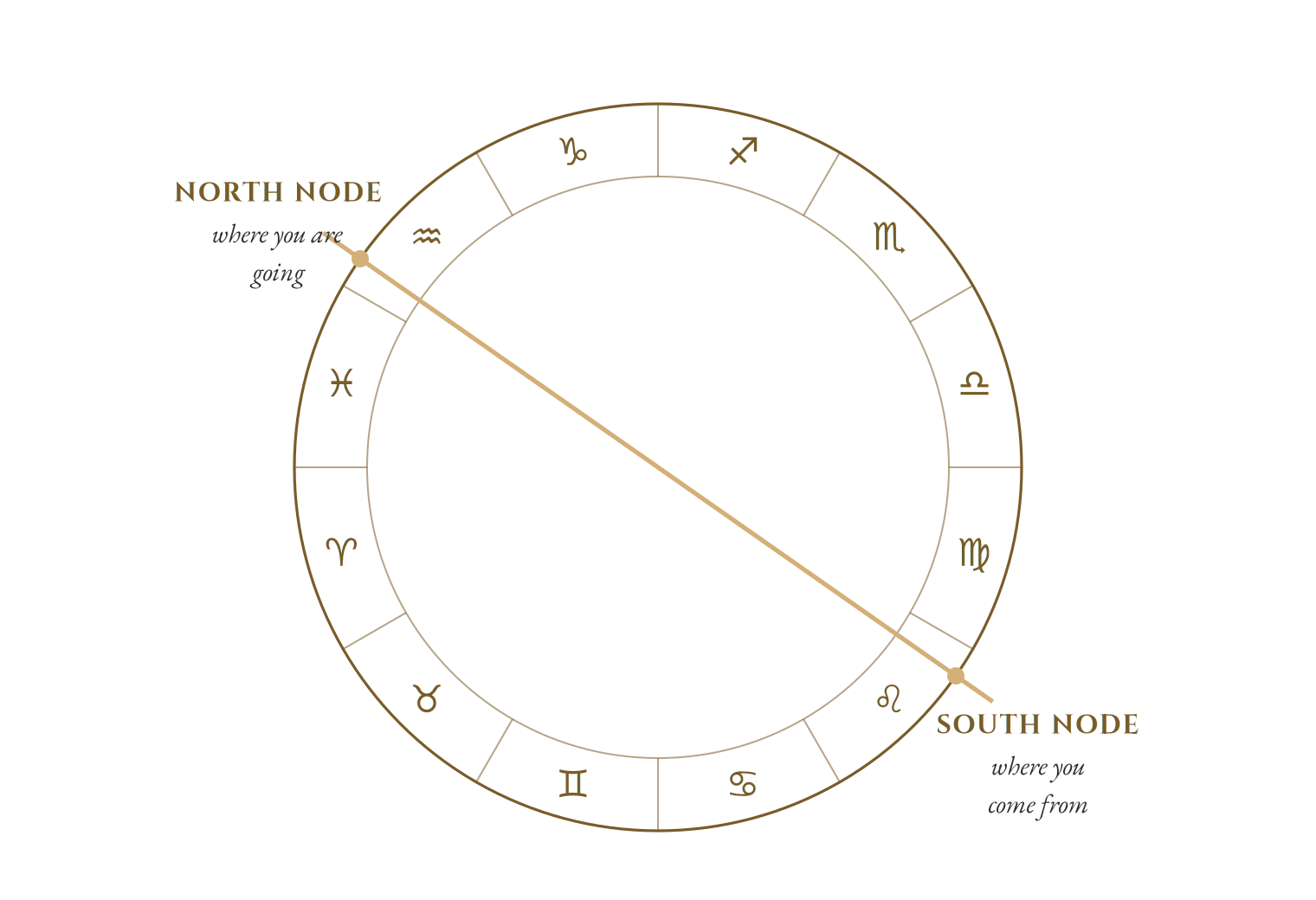
The nodes are not a body at all. They are two points in empty space, the two spots where the Moon's path around the Earth crosses the Sun's path through the sky. You cannot see them because there is nothing there to see, and the tradition has used them for thousands of years anyway, which tells you the old astrologers were reading geometry and not just watching lights. They are the ancient one of the three.
They always come as a pair, exactly opposite each other, a single axis drawn straight across the whole chart. One end is the South Node, and it describes where you come from. The things you already know how to do, the moves so natural you reach for them without thinking. There is real talent stored there, and it is also the rut, the groove you overuse because it is the easy one. The other end is the North Node, and it points the opposite way, toward what the life is trying to grow into. That direction almost never feels natural. It feels awkward and slightly against the grain, and it tends to be the thing that actually nourishes you once you stop avoiding it. Some people hear past lives when they hear the nodes, and you can take that literally or leave it, because you do not need it. The plain version is enough. The South Node is the default you were handed and the North Node is the stretch that grows you, and a life tends to move, slowly and never in a straight line, from the one toward the other.
The end of the actors
That is the whole cast. Ten planets, Chiron, Lilith, and the two ends of the nodal axis. Every point on your wheel that does something, you can now name, and you can say the first half of its sentence. This is my Chiron, where I was hurt and where I can help. This is my North Node, the direction that grows me.
What you still cannot do is read any of it in real detail, because so far you have only met the actors. You do not know their costumes yet. That is the next block, the signs, twelve of them, and each one changes how an actor behaves without changing what it is underneath. Up to now the sentence has come out half empty every single time. Starting next, the second half arrives, and the chart finally begins to say something.