A sentence you already read
Take an ordinary sentence about someone. Your aunt spends money carefully. Without thinking, you split it into pieces: someone acting, a manner, a setting. You handle that structure a hundred times a day.
A chart line is built the same way. It has a part for what is acting. A part for the manner. A part for the area of life where it shows up. Then one part more that a plain sentence keeps hidden: whether this line is on good terms with another line elsewhere on the page.
Four slots, then. Once you can see the four of them empty, everything the next blocks bring has somewhere to sit instead of piling up as loose facts. The meanings come later. Today is only the slots.
Here they are.
The planet is the what
A planet is the thing doing something. The part of you that is switched on.
You met them in Lesson 1. The seven older bodies anyone can see without a telescope and the four later ones with their discovery dates. Each stands for a kind of activity. The Sun for the core of who you are. The Moon for what you need in order to feel steady. Venus for what you are drawn to and what you value. Mercury for the way you think and talk.
When a chart mentions a planet, ask the plain question first. What is this one in charge of. That answer is the what of the sentence. The next block of the course does nothing but go through the planets one at a time. A light grip is enough for now.
The sign is the how
In Lesson 2 a sign was a thirty degree stretch of the ring, one of twelve equal slices around the rim. That told you where a planet sits. It did not yet tell you what the sign itself contributes.
Here is the job it does. The sign is the manner. It colours how the planet goes about its work.
Two people can have the same planet doing the same job in completely different styles. The sign is most of the reason. One person's Venus reaches for what it wants slowly and takes its time. Another's goes straight at it. Same planet, same what. The how is nowhere near the same.
A warning that saves trouble later. The sign describes how one planet behaves, not the whole person. "I'm a Leo" usually means the Sun happens to sit in that one slice, which is a single word out of the dozen or so in a full chart. Lesson 9 takes this apart properly. For now, treat a sign as an adverb fixed to one planet and nothing grander.
The house is the where
The third slot is the area of life the whole thing plays out in.
Lesson 2 pointed at the wedges inside the circle and called them houses without opening them up. This is what they answer. The chart cuts ordinary life into twelve areas. Money. Home. Work. Friendship. The one a planet falls into is its where.
So two of the four slots come from the planet and its sign. The third comes from the house it lands in. The same energy turns up in a different corner of your days depending on which house holds it.
This slot leans hardest on your birth time, for the reason Lesson 2 gave. The houses hang off the horizon. The horizon depends on the minute and the place you were born. Block four reads them in full. A light touch is enough here.
The aspect is the conversation
The first three slots describe one planet on its own. The fourth is about how two of them get along.
Planets sit at various distances around the ring. When two of them land at particular angles to each other, astrologers say they are in aspect, which is a way of saying the two are in conversation. Lesson 1 named these angles in passing. Here is what they add.
Some of those conversations run smoothly. The two planets back each other up and you tend not to notice the ease, the way you rarely notice something that never gives you trouble. Others are full of friction. The two keep pulling in different directions and you feel it. Neither kind is good or bad in itself. Easy aspects can go slack from lack of pressure and hard ones often build the most, which is why the useful question is what a given pairing tends to ask of you rather than whether it counts as lucky.
This is the slot that turns four separate words into a sentence with tension in it. It comes properly in block five.
One line, read in full
Put the four together on one example and the sentence stands up.
Say a chart has the Moon in Cancer, sitting in the fourth house, on easy terms with Venus. Read it slot by slot. The Moon is your emotional needs. Cancer gives them a protective, tender manner. The fourth house sets them in the area of home and family. The easy tie to Venus means what you love tends to back them up.
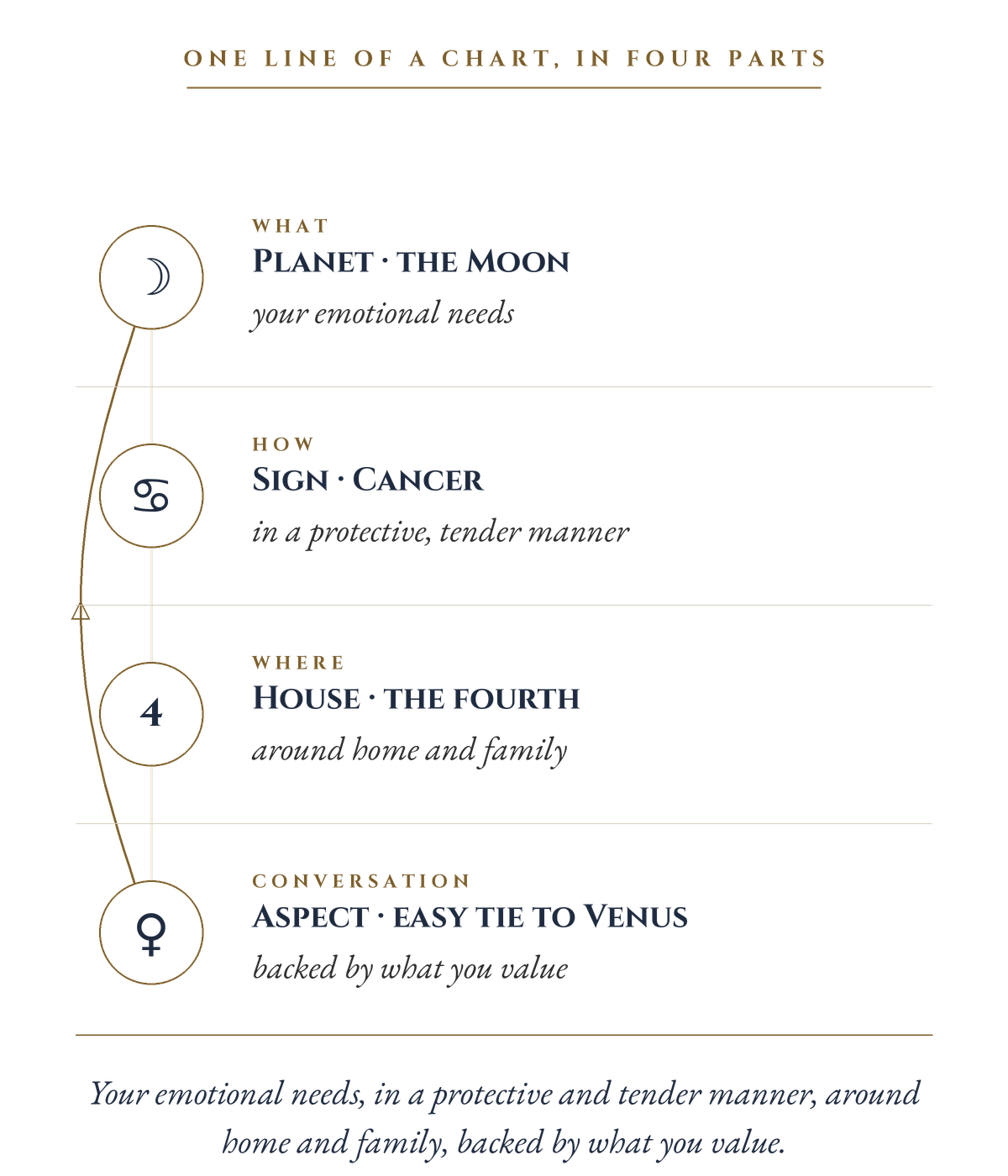
That is a single line of a chart said out loud. A real one holds a page of them. The skill is mostly patience: taking them one at a time instead of letting the whole drawing shout at once. A long reading is what it looks like when someone does this for every line and then works out how the lines answer one another.
Before you go on
One small thing, on your own chart this time.
Pick any planet you can find. The Sun and the Moon are easiest, since you located both back in Lesson 2. Read off the sign it sits in. Now say the two-word core out loud: this planet, doing its work, in the manner of that sign. Your Moon in Gemini. Your Venus in Scorpio.
That much is the what and the how. It is already half the sentence. The where and the conversation are what the coming blocks put in your hands. For now, leave the meaning alone. The job today is only to feel where each part goes.
Next: The Two Lights: Sun and Moon →
All twenty-seven lessons