Why the drawing is a circle
The first time somebody puts a birth chart in front of you the reaction tends to be the same. Too much is happening at once. Numbers around the rim and symbols nobody has explained, lines crossing the middle at angles that look arbitrary.
Nearly all of that confusion comes from one question that nobody bothers to answer first. Why is it round?
Go and stand outside. Go outside and look up. Now turn around slowly. The sky does not stay behind you. It wraps the whole way round and carries on under your feet to the far side of the planet.
A drawing that wanted to be honest about that would have to be a sphere with you in the middle. Since that is awkward on paper, astrologers flatten the band of sky where the Sun and the planets travel and lay it out as a ring around you.
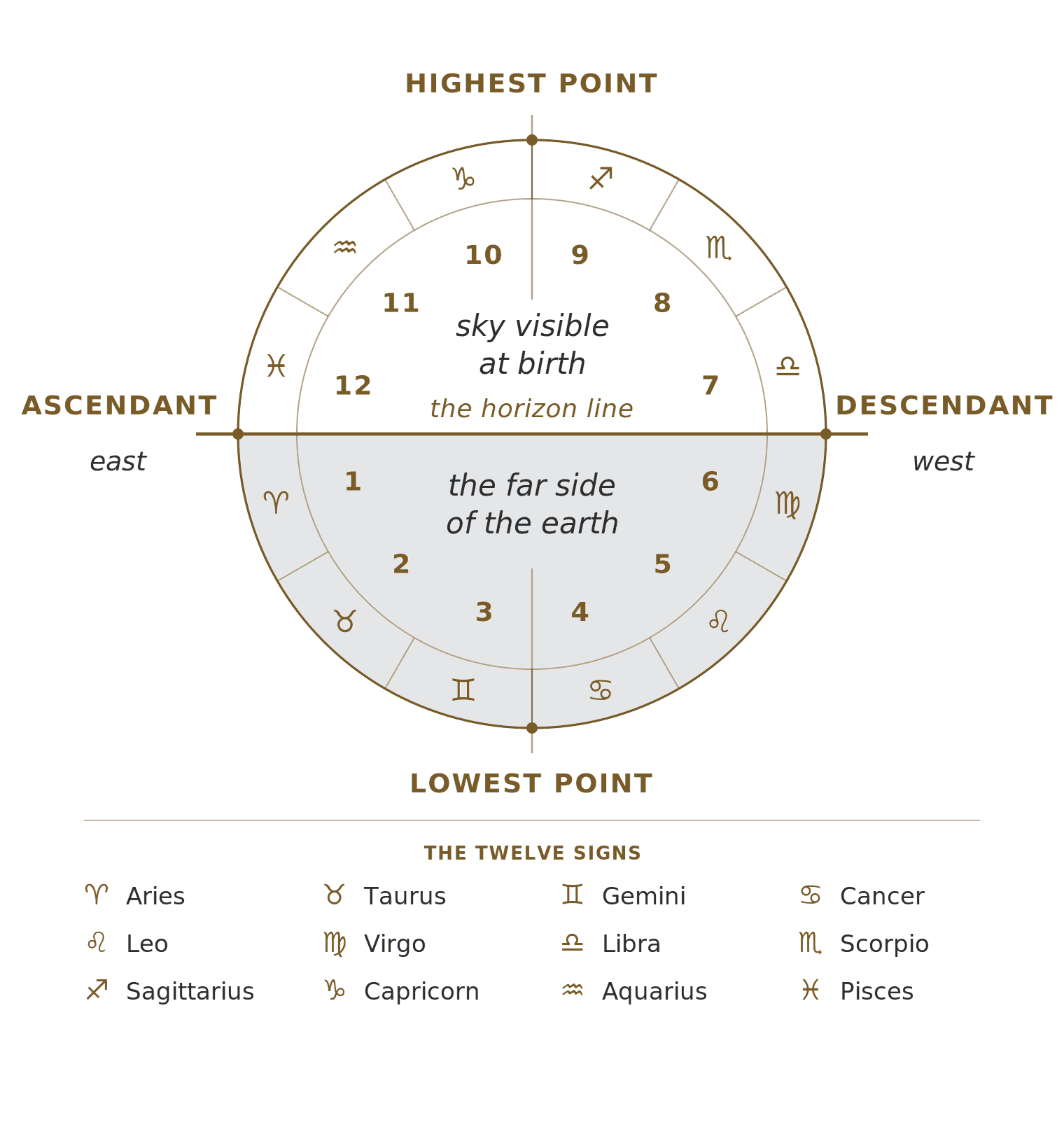
Worth saying plainly. Flattening loses something, the same way a flat map of the world swells Greenland to the size of Africa. What you end up with is a working diagram. It keeps whatever matters for reading and discards the rest.
Once you accept that you are standing in the middle of the ring, most of the confusion goes.
Look at the band running around the outer edge of the drawing, the outermost one, where the symbols are printed. That full band measures 360 degrees. Split it evenly into twelve stretches and each stretch gets 30. Those twelve stretches are the signs. Every sign is exactly the same size as every other one, which surprises people who assume some are bigger.
This is where the numbers printed next to each planet come from. If a chart tells you the Sun sits at 15 degrees of Taurus, it means the Sun was halfway through that particular 30 degree stretch. At 2 degrees of Taurus it had only just entered. At 28 it was nearly out the other side.
Think of the face of a clock. Twelve divisions around the edge. You read a position by saying how far past a mark the hand has travelled. The chart works the same way with a finer scale.
That is all a degree is here. A measurement of how far around the ring something sits. No meaning attached to the number yet.
The line across the middle
Now the part that turns a generic sky into your sky.
Look at the horizontal line that runs across the middle of the drawing from left to right. That line is the horizon of the place where you were born. Your horizon. The one you would have seen from that hospital or that house if somebody had carried you outside and held you up to look.
The left-hand end of that line is the most personal point in the whole chart. It marks the degree that was climbing over the eastern horizon at the minute you were born, the piece of sky that was coming up right then. Astrologers call it the Ascendant. You will also hear it called the rising sign.
This is the reason the previous lesson asked you to hunt down your exact birth time. The earth turns a full rotation every twenty-four hours, which drags that eastern point all the way around the ring in the same period. It moves through a new sign roughly every two hours. Two people born on the same day in the same town at different times of the morning end up with a different sign at that left-hand end and the planets scattered across different parts of the page.
On paper that line always sits horizontal with the Ascendant always on the left. What turns with the passing hours is the whole sky behind it. Change the time and a different degree comes up at that end. Everything else on the page shifts along with it.
Above the line and below it
Here is the part that makes the drawing readable. Almost nobody explains it.
Anything drawn above the horizontal line was up in the visible sky when you were born. It was over the horizon. Somebody standing outside at that moment could have pointed at it.
Anything drawn below the line was on the far side of the earth. Under the ground, from where you were. Out of sight.
The top of the drawing is the part of the sky that stood highest overhead at that minute, the place the Sun reaches at midday. The bottom of the drawing is the opposite point, straight down past your feet.
So the ring records what stood overhead and what lay hidden underneath.
There is a quick way to test all of this against something you already know. The Sun crosses the whole ring in a day like everything else in the sky. Where it sits tells you roughly what time of day you arrived. Born around dawn and the Sun sits close to the left-hand end of the horizontal line, barely clear of it.
Born near midday and it sits somewhere along the top. Born in the evening and it has swung across to the right-hand side where it goes down. Born in the small hours and it is at the bottom of the page, under your feet.
This has one consequence you can check on your own chart in about ten seconds. If your Sun is drawn above the horizontal line, you were born during daylight. If your Sun is drawn below it, you were born at night. The drawing tells you something you already know about your own birth, which is a useful first proof that the drawing is describing something real.
The rest of the page
Then there are the little marks. Some of them look vaguely like what they stand for and most of them do not.
They are shorthand, the kind that develops in any trade where people write the same words thousands of times. A scribe copying charts by hand needed something faster than writing out Jupiter every single time. The marks stuck around because they save space on a crowded page.
Nobody learns them by sitting down with a list. They arrive through use, in the same way you stopped needing to sound out road signs at some point without ever studying them. Over the next lessons you will see the same handful of marks so often that they stop being decoration and start being words. Any chart you look at in the meantime comes with its key printed on it.
One more thing on the page needs naming before we leave it alone. You will notice the inside of the circle is cut into twelve wedges by lines running out from the centre, like a sliced cake.
Although they look like another version of the stretches around the rim, these wedges belong to a second division called houses which sits on top of the first one. You can tell the two apart at a glance because the wedges come in different widths while the stretches around the rim are all equal. Signs divide up the sky. Houses divide up ordinary life.
We are naming them here so you know what you are looking at. The whole of block four is given over to them and there is nothing you need to do about them yet.
If the drawing still looks like too much, that is the normal reaction and it does not mean anything about your aptitude. There is a lot of information packed into a small space and none of it is labelled in plain English. Most people go through several weeks of finding a chart unreadable before something clicks and it turns into an image they can take in at a glance. By the end of this course this same picture will read itself.
For now, two things only.
Find the left-hand end of the horizontal line on your own chart and put your finger on it. That is your Ascendant.
Then find your Sun and notice which side of that horizontal line it sits on. If you were born in daylight it has to be above. If you were born at night it has to be below. If it does not match, something went wrong when the chart was calculated and the first thing to check is the time you typed in, because that mistake is one of the most common ones.
That is the whole exercise. Do not try yet to work out what any of it means, since that comes later and guessing now tends to plant ideas that are hard to shift.
Next: The Four Words a Chart Is Made Of →
All twenty-seven lessons